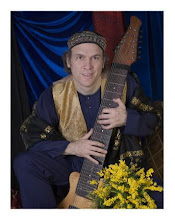
Does Islam forbid Music? Many Muslims think so, and many of those Muslims are in positions of power and influence, thanks to the oil money that finances Salafi teachings. But the majority of Muslims believe otherwise. Almost all of my music teachers are Muslims, and almost every Muslim culture-Pakistan, Arabia, Egypt, Persia- has a rich and beautiful musical tradition of its own. So where does this idea of music being forbidden come from?
There is nothing in the Koran that specifically forbids music. This prohibition comes entirely from controversial interpretations of the Hadith, the sayings of the prophet which were written down by those who interviewed people who had known Muhammad. I think that studying the Hadith is very worthwhile. Muhammad was an extraordinary human being, and one can learn a lot from seeing the skillful and creative way he dealt with the challenges that were given him. Perhaps more importantly for Muslims, it's impossible to understand the Koran (or any other text) unless one is familiar with the historical context in which it was written or spoken. However, Muslim scholars have never treated the Hadith with the same level of reverence as the Koran, and this is how it should be. There is a complex ranking system used for evaluating the reliability of the hadith, depending on who was speaking and who was writing them down. Also, It would be blasphemous to say that Muhammad's words, admirable though they are, should be given the same authority as the Koran. The Koran is the word of God, and it would be idolatry to forget that Muhammad's words are literally sacred only when God is speaking through him.
There are thus two equally effective ways for criticizing the Hadith scholarship that produced the ban on music. First of all, the three hadiths that are cited are both questionable and ambiguous. Sheikh Yusuf Al-Qaradawi has a detailed criticism of both the historical reliability and the anti-musical interpretation of these Hadith. In the first hadith, Muhammad criticizes idle talk, which for some reason is interpreted by a cleric named Ibn Mas`ud as referring to singing. In the other two hadiths, Muhammad allegedly speaks of an apocalyptic time in the future when the Ummah will be punished by Allah for doing a variety of sinful things. Amongst the activities listed are wearing silk, adultery, drinking alcohol, listening to female singers, and playing stringed instruments. Al-Qaradawi points out that there is not an unbroken line tracing these hadiths back to the prophet himself and thus they are questionable.
In Al-Qaradawi’s words: all these hadiths are declared ‘weak’ by the followers of Ibn Hazm, Malik, Ibn Hanbal, and Ash-Shafi`i. In his book, Al-Ahkam, Al-Qadi Abu Bakr Ibn Al-`Arabi says, “None of the hadiths maintaining that singing is prohibited are considered authentic (by the scholars of the Science of Hadith Methodology).” The same view is maintained by Al-Ghazali and Ibn An-Nahwi in Al-`Umdah. Ibn Tahir says, “Not even a single letter from all these Hadiths was proved to be authentic.”Ibn Hazm says, “All the hadiths narrated in this respect were invented and falsified.” Al-Qaradawi also points out that this text could be seen as a general description of license and excess, with the details of drink, music etc. added to show the kind of atmosphere created by excess. Just because all of these things together are forbidden, that does not mean that each of them would be.
Those who accept these hadiths as authentic and/or anti-musical must also account for the fact that there are numerous other hadiths in which Muhammad permits and encourages music. There are stories, for example that tells of some of Muhammad’s people who were celebrating by singing and dancing. When Muhammad’s counselors complained, Muhammad said that they should continue to sing and play. In one case, Muhammad specifically ordered that a singer be sent to accompany a wedding ceremony. There are also numerous historical documents describing musical celebrations by Muhammad’s people in Medina. The music-haters respond to this by saying that these documents only describe music made with voice and drums, and therefore what is forbidden is instrumental music, particularly stringed instruments. Apparently the assumption is that whatever isn’t specifically permitted is forbidden.
Al-Qaradawi points out however, that there is a famous passage in the Koran which says exactly the opposite, and gives a second way of the responding to these arguments. The Koran arguably forbids the whole procedure of inferring any sort of taboos and prohibitions from any hadith. To quote Al-Qaradawi again:
“We do have a good example to follow from one of our earlier pious scholars. Imam Malik (may Allah be pleased with him) who said: “It was not the habit of those who preceded us, the early pious Muslims, who set good example for the following generations, to say, 'This is halal, and this is haram. But, they would say, ‘I hate such-and-such, and maintain such-and-such, but as for halal and haram, this is what may be called inventing lies concerning Allah. Did not you hear Allah’s Statement that reads, 'Say: Have you considered what provision Allah has sent down for you, how you have made of it lawful and unlawful? Say: Has Allah permitted you, or do you invent a lie concerning Allah?” (Yunus: 59) For, the halal is what Allah and His Messenger made lawful, and the haram is what Allah and His Messenger made unlawful.”
And if I may provide one more argument of my own: If Allah wanted to institute a command as radical as banning music, isn’t it highly implausible that he would have buried it in a couple of highly questionable hadiths? He could have eliminated all doubt by simply saying “Don’t play music” in the text of the Koran itself.
Tuesday, December 22, 2009

Tuesday, December 8, 2009
Here's the muslim outrage!

theamericanmuslim.org
I wish I could find a way of keeping this link permanently on the top of my page. If there's anyone who knows how, please let me know on the comment page. Also if there's some way I could link to this image rather than the text above I would love to know that as well. For all the people who keep saying Muslims should speak up against terrorism: Many Muslims are doing so, but most people don't hear about it because Bombs are much more likely to hit the front page than are petitions. Click on this link and check them out.
Monday, December 7, 2009
Albanian Guest Blogger
I found this on the comments page of an NYTimes article. signed simply "David, New Jersey". I really liked it, and present it without comment.
Mr. Douthat, as an American of Albanian descent who happens to be Orthodox Christian, I am deeply offended by your simplistic, myopic portrayals of Europe's Muslim communities, but I am not surprised. Your writing on this subject, as with many others before this, is rife with Fox Network-inspired talking points and glitzy, contrived mots justes ('Eurabia', 'Clash of Civilizations' and 'dhimmitude'). This piece could have been written by any wide-eyed, fearful Evangelical Christian who's never left the deep south, and frankly, Mr. Douthat, it already has been - many, many times over. You paint with an extra-wide brush here about yet another large segment of humanity of which you seem to know next to nothing, and with which it would appear you have had zero meaningful contact. Europe is not now, nor has it ever been all Christian, all Western, all the time. Get to know Europe's indigenous Muslims in their countries of origin, Mr. Douthat, and have your eyes opened for you. Albania had more Jews in it after World War Two than it did before. I used to attend Albanian school on Fridays at the Albanian Islamic Center in Waterbury, Connecticut. My father used to drive me there - it was about forty-five minutes from our home. Like me, he felt it was important to maintain a connection to Albanian language and culture. After my language class was over, and patriotic songs sung, I used to sit in on the religion class, so that I could learn about Islam. I would even go up into the mosque to pray alongside my classmates - all American-born teenagers and children. The Imam was a wise older man who was aware that I was an Orthodox Christian (my Godparents were known and loved by many in this community). He always made me know that I was welcome to pray, in my own way, right alongside the other kids. I would watch their motions and prostrations as I silently said the Lord's Prayer, and made the sign of the cross. I enjoyed hearing the call to prayer, and listened attentively to the sermon (hutbe), which was always about loving and helping one another, forgiveness - much the same things as I'd hear in church on Sunday. In short, I understood from a very young age that Muslims weren't any different from Christians or Jews. The only time I ever saw any women with headscarves on was when they walked into the mosque to pray. Otherwise, once they were outside, the headscarves went into purses, the kids went into the car, and everyone went off to have pizza. Visit Albania and you will see the situation is identical there today. Because Albanians have suffered together through the ages, and share an ancient, unique language which binds them together, we have always felt ourselves to be Albanians first. Our people intermarry across religious lines, and have a strong tradition of the separation of church and state. Albania: statistically 65% Muslim and 35% Christian and 100% European and proud of it.
Mr. Douthat, as an American of Albanian descent who happens to be Orthodox Christian, I am deeply offended by your simplistic, myopic portrayals of Europe's Muslim communities, but I am not surprised. Your writing on this subject, as with many others before this, is rife with Fox Network-inspired talking points and glitzy, contrived mots justes ('Eurabia', 'Clash of Civilizations' and 'dhimmitude'). This piece could have been written by any wide-eyed, fearful Evangelical Christian who's never left the deep south, and frankly, Mr. Douthat, it already has been - many, many times over. You paint with an extra-wide brush here about yet another large segment of humanity of which you seem to know next to nothing, and with which it would appear you have had zero meaningful contact. Europe is not now, nor has it ever been all Christian, all Western, all the time. Get to know Europe's indigenous Muslims in their countries of origin, Mr. Douthat, and have your eyes opened for you. Albania had more Jews in it after World War Two than it did before. I used to attend Albanian school on Fridays at the Albanian Islamic Center in Waterbury, Connecticut. My father used to drive me there - it was about forty-five minutes from our home. Like me, he felt it was important to maintain a connection to Albanian language and culture. After my language class was over, and patriotic songs sung, I used to sit in on the religion class, so that I could learn about Islam. I would even go up into the mosque to pray alongside my classmates - all American-born teenagers and children. The Imam was a wise older man who was aware that I was an Orthodox Christian (my Godparents were known and loved by many in this community). He always made me know that I was welcome to pray, in my own way, right alongside the other kids. I would watch their motions and prostrations as I silently said the Lord's Prayer, and made the sign of the cross. I enjoyed hearing the call to prayer, and listened attentively to the sermon (hutbe), which was always about loving and helping one another, forgiveness - much the same things as I'd hear in church on Sunday. In short, I understood from a very young age that Muslims weren't any different from Christians or Jews. The only time I ever saw any women with headscarves on was when they walked into the mosque to pray. Otherwise, once they were outside, the headscarves went into purses, the kids went into the car, and everyone went off to have pizza. Visit Albania and you will see the situation is identical there today. Because Albanians have suffered together through the ages, and share an ancient, unique language which binds them together, we have always felt ourselves to be Albanians first. Our people intermarry across religious lines, and have a strong tradition of the separation of church and state. Albania: statistically 65% Muslim and 35% Christian and 100% European and proud of it.
Saturday, December 5, 2009
The Swiss Minaret Ban
There have been a lot of confusions between things the Swiss might have done and what they actually did. There would arguably have been justification for certain neighborhoods banning the sound of the call to prayer, if it was interfering with people's sleep. I wouldn't have asked for it. I have a gospel church near my house, and I rather like hearing the singing each sunday morning. (I'm somewhat annoyed by the parking problems the Church services produce, but I can live with that.) But I can understand how some people might make such a zoning request, and I wouldn't see that as religious prejudice (just grouchiness). Perhaps in a historical neighborhood, a minaret might be declared architecturally inappropriate. But this is a ban for an entire country. That is wrong, and clearly motivated by religious prejudice. In fact, according to Al Jazeera, the regions of Switzerland where the four minarets existed actually voted against the ban, so it was not a problem caused by the minarets themselves that inspired this ban. It was the idea of minarets that bothered people who had never actually had one in their neighborhoods.
Those alleged feminists who worked for the ban should have collaborated with Islamic feminists (yes, there are such things) to make the changes in the Islamic community they wanted. This ban will make it much harder to do that.
Much of the discussion on this topic relies on a fallacy that is so old it has a Latin name: the Tu quoque argument. "You do X, so how can you can complain that we do X?". Tu quoque arguments can always be turned back on the person who makes them "You complain when we do X, so how can you do X yourself?" Also the word "you' refers to a two different set of people each time it occurs in the sentence. The Muslims complaining about this are not the ones in the Saudia Arabian Government who do this. (I believe Saudia Arabia is actually the only Muslim country that bans the practice of other religions, but I could be wrong about this.)
Also, I am virtually certain that there is no country in Western Europe that actually recognizes Sharia law as part of their legal system in any way whatsoever. If anyone has any actual evidence of such recognition, I'd like to see it. No unsupported assertions please, just actual evidence, preferably with a link as reference.
The Archbishop of Canterbury proposed the possibility that Sharia courts might be permitted to arbitrate in civil disputes. Licensed private firms in both American and England are already permitted to do this; The Archbishop was just suggesting that Sharia courts be granted those licenses. This idea was attacked by almost everyone who heard about it, and was never carried out. I thought it was an acceptable idea at first, but after reading some objections by Islamic feminists, I realize that this strengthens patriarchal structures in Islamic cultures in ways that make liberalization of Islam difficult. These patriarchal structures are more cultural than Islamic, and many Muslims want to change them. Things like the minaret ban make it much harder for them to do so.
Those alleged feminists who worked for the ban should have collaborated with Islamic feminists (yes, there are such things) to make the changes in the Islamic community they wanted. This ban will make it much harder to do that.
Much of the discussion on this topic relies on a fallacy that is so old it has a Latin name: the Tu quoque argument. "You do X, so how can you can complain that we do X?". Tu quoque arguments can always be turned back on the person who makes them "You complain when we do X, so how can you do X yourself?" Also the word "you' refers to a two different set of people each time it occurs in the sentence. The Muslims complaining about this are not the ones in the Saudia Arabian Government who do this. (I believe Saudia Arabia is actually the only Muslim country that bans the practice of other religions, but I could be wrong about this.)
Also, I am virtually certain that there is no country in Western Europe that actually recognizes Sharia law as part of their legal system in any way whatsoever. If anyone has any actual evidence of such recognition, I'd like to see it. No unsupported assertions please, just actual evidence, preferably with a link as reference.
The Archbishop of Canterbury proposed the possibility that Sharia courts might be permitted to arbitrate in civil disputes. Licensed private firms in both American and England are already permitted to do this; The Archbishop was just suggesting that Sharia courts be granted those licenses. This idea was attacked by almost everyone who heard about it, and was never carried out. I thought it was an acceptable idea at first, but after reading some objections by Islamic feminists, I realize that this strengthens patriarchal structures in Islamic cultures in ways that make liberalization of Islam difficult. These patriarchal structures are more cultural than Islamic, and many Muslims want to change them. Things like the minaret ban make it much harder for them to do so.
Tuesday, December 1, 2009
The Evil Empire from the East
When David Brooks talks about the narrative that shapes both Islamic extremism and our fear of it, he would do well to consider how deeply rooted this narrative is. Ever since Xerxes and Darius tried to invade Greece around the 4th century B.C., western Europe has been haunted by the fear that a powerful empire from the East would invade and plunge the world into a second darkness. The Movie 300 artfully (and somewhat creepily) connected this story to modern phobias by portraying the Persians as wearing turbans, and the Persian emperor as some sort of bizarre bejeweled half-naked quasi-African tribal chief. It also ignored the fact that life under the Persian empire was arguably closer to modern democracy than the fascistic monarchy of the Spartans. The constant rhetoric about "freedom" from a king who deliberately flouted the rulings of the city council reminded me a lot of George Bush.
After the Persians gave up on trying to conquer Europe, the eastern empire myth was continually reinforced by the fact that 1) Nobody wants to live in the Gobi desert and 2) Anyone who has learned how to survive in the Gobi desert is probably tough enough to grab any piece of real estate they want. Consequently, Europe was perennially threatened by tribes riding forth out of what is now Mongolia and into Europe: The Huns, the Mongols, the Seljuk Turks, the Ottoman Turks. The fact that the Arab Muslims managed to convert the last two groups, and stage an impressive invasion of their own, managed to tie this fear of Easterners to Islamophobia.
The main reason that the Gobi desert warriors were so dangerous is that they were brilliant horsemen. I believe they invented the stirrup, which greatly increased the flexibility of a mounted warrior, and there is lots of documentary footage showing that the Mongols are as good at horseback riding as they ever were. Towards the end of his career, Buffalo Bill added Mongolian horsemen to his Wild West Show, and renamed it "Rough Riders East and West." Now that the horse is essentially useless militarily, the Mongols have become the sweetest, most harmless people you are ever likely to meet. Nevertheless, Orientophobia has been transferred to other targets, and lives on in both literature and foreign policy.
Both Lord of the Rings and the Chronicles of Narnia rely heavily on Orientophobic images derived from medieval epic literature. The human beings who fight for Sauron in the Lord of the Rings have black curly hair, dark skin, gold earrings, and ride on "Oliphaunts". The Orcs and Urukai are patterned after European superstitions about the Mongols, including cannibalism and the use of dragons in battle. The great Calormen empire that lies south of Narnia is inhabited by people who have turbans, scimitars, dark skin, and a poetic speaking style patterned after the Arabian Nights. In The Last Battle, Calormen conquers Narnia, which eventually ushers in Judgment Day. Both authors were temperamentally very tolerant people, and were careful to surgically remove these racist images from their historical context. Tolkien, sensitive to the dangers of racism against actual humans, mentions that the Oliphaunt riders must have been duped or misled by Sauron. (There is no danger of roving bands of skinheads beating up elves.) Tolkien also combined fear of the East with fear of industrial squalor to create a completely new and nonhistorical vision of Imperialistic evil. C.S. Lewis had the Calormens worshiping a god called Tash, who was very like the polytheistic gods that Muhammad was campaigning against.
When the Islamic empires were colonized by the West, the Islamic images of Orientophobia also faded into the background. Nevertheless, politicians and generals where still able to manipulate these fears for rhetorical effect. During World War I, The Germans were referred to as "Huns" (well, Germany is east of France). After World War II, the Communists replaced Islam as the Eastern Bugbear of choice, for it was clearly their intention to conquer the world. Once Communism collapsed, however, there was something even scarier to fear: Nothing. As Heidegger pointed out, Nameless Dread (which he called Angst) is much harder to deal with than any particular enemy. For several years after the Berlin wall fell, the question kept hovering in the background "What do we need all of these weapons for?". The only answer was "Well, the World is a pretty dangerous place."
And then we were rescued from Anxiety, and delivered into Fear, by 9/11. Here was our dear familiar enemy, The Evil Empire from the East, with all of the trappings we had been trained to respond to: The turbans, the beards, the violent attacks, the threat of world domination. The number of people who actually called for the latter was only in the low thousands, possibly even hundreds, but with so much Pavlovian training, the slightest stimulus could trigger a response.
After the Persians gave up on trying to conquer Europe, the eastern empire myth was continually reinforced by the fact that 1) Nobody wants to live in the Gobi desert and 2) Anyone who has learned how to survive in the Gobi desert is probably tough enough to grab any piece of real estate they want. Consequently, Europe was perennially threatened by tribes riding forth out of what is now Mongolia and into Europe: The Huns, the Mongols, the Seljuk Turks, the Ottoman Turks. The fact that the Arab Muslims managed to convert the last two groups, and stage an impressive invasion of their own, managed to tie this fear of Easterners to Islamophobia.
The main reason that the Gobi desert warriors were so dangerous is that they were brilliant horsemen. I believe they invented the stirrup, which greatly increased the flexibility of a mounted warrior, and there is lots of documentary footage showing that the Mongols are as good at horseback riding as they ever were. Towards the end of his career, Buffalo Bill added Mongolian horsemen to his Wild West Show, and renamed it "Rough Riders East and West." Now that the horse is essentially useless militarily, the Mongols have become the sweetest, most harmless people you are ever likely to meet. Nevertheless, Orientophobia has been transferred to other targets, and lives on in both literature and foreign policy.
Both Lord of the Rings and the Chronicles of Narnia rely heavily on Orientophobic images derived from medieval epic literature. The human beings who fight for Sauron in the Lord of the Rings have black curly hair, dark skin, gold earrings, and ride on "Oliphaunts". The Orcs and Urukai are patterned after European superstitions about the Mongols, including cannibalism and the use of dragons in battle. The great Calormen empire that lies south of Narnia is inhabited by people who have turbans, scimitars, dark skin, and a poetic speaking style patterned after the Arabian Nights. In The Last Battle, Calormen conquers Narnia, which eventually ushers in Judgment Day. Both authors were temperamentally very tolerant people, and were careful to surgically remove these racist images from their historical context. Tolkien, sensitive to the dangers of racism against actual humans, mentions that the Oliphaunt riders must have been duped or misled by Sauron. (There is no danger of roving bands of skinheads beating up elves.) Tolkien also combined fear of the East with fear of industrial squalor to create a completely new and nonhistorical vision of Imperialistic evil. C.S. Lewis had the Calormens worshiping a god called Tash, who was very like the polytheistic gods that Muhammad was campaigning against.
When the Islamic empires were colonized by the West, the Islamic images of Orientophobia also faded into the background. Nevertheless, politicians and generals where still able to manipulate these fears for rhetorical effect. During World War I, The Germans were referred to as "Huns" (well, Germany is east of France). After World War II, the Communists replaced Islam as the Eastern Bugbear of choice, for it was clearly their intention to conquer the world. Once Communism collapsed, however, there was something even scarier to fear: Nothing. As Heidegger pointed out, Nameless Dread (which he called Angst) is much harder to deal with than any particular enemy. For several years after the Berlin wall fell, the question kept hovering in the background "What do we need all of these weapons for?". The only answer was "Well, the World is a pretty dangerous place."
And then we were rescued from Anxiety, and delivered into Fear, by 9/11. Here was our dear familiar enemy, The Evil Empire from the East, with all of the trappings we had been trained to respond to: The turbans, the beards, the violent attacks, the threat of world domination. The number of people who actually called for the latter was only in the low thousands, possibly even hundreds, but with so much Pavlovian training, the slightest stimulus could trigger a response.
Tuesday, November 24, 2009
What is a "Link"?
One of the most maliciously confusing words in contemporary discourse is "link". It was used to great effect during Obama's presidential run, during which he was "linked" to his former minister, to a group who registered voters for him, and to a guy he met once at a party who blew stuff up when Obama was eight years old. One "link" that allegedly helped to justify the Iraq war was a communication in which Osama Bin Laden asked for help, and Sadam Hussain refused it. Before and after that conversation, each man offered a reward for killing the other, which apparently didn't weaken the link significantly. And then there is the Mother of all Links: George Bush's "Axis of Evil". For the historically challenged, the original Axis was an alliance between Fascist Italy, Nazi Germany and Imperial Japan, who signed a treaty which outlined a detailed plan for world conquest which was financed with billions of dollars, and executed by millions of trained soldiers, weapons, and military transport. . Bush's "Axis of Evil" consisted of two countries who had been at war with each other for over a decade, and a third country that barely knew the other two existed. When I first said this, someone told me that Korea was "linked" to one of these other countries (I forget which, because I don't care) because it had allegedly sold it nuclear material. The word "link" blurs the fact that there is a tremendous difference between being a military ally and being a customer. I have frequently bought french fries at McDonalds. Does that make me and McDonalds part of the Axis of French Fries?
The men who overpowered airplanes and crashed them into the World Trade Center were not just "linked". They were organized and co-ordinated in essentially the same way that a football team or an army is co-ordinated. To conflate this kind of organization with a "link" that consisted of a few emails between an Imam and a single soldier is to be dangerously confused. One of the things that makes this kind of confusion even more likely is that no terrorist organization has done anything as remotely well co-ordinated since, and consequently there really isn't that much difference between terrorists and lone gunmen today. There is a difference in degree but today there is no real sharp way to draw the line. Al Qaeda once had almost completely political control of Afghanistan , which became their base of operations for something that resembled a genuine military campaign. That base was destroyed during the war with Afghanistan, and now Al Qaeda is nothing but a disorganized group of malcontents that share little more than a willingness to wear the same T-shirt.
The underlying assumption of the controversy around Fort Hood has been that if we see lots of similarities between Hasan and Al Qaeda, this must prove that Hasan is somehow part of the same Mass-movement as Al Qaeda, and therefore should be feared. What I am saying is the fact that there are so many similarities between Hasan and Al Qaeda shows that we should consider both to be ordinary criminals, not a major military threat. There is not that much difference between Hasan and the other nutcases blowing things up in the name of Islam, because all the so-called Jihadists are a rag tag bunch of losers, who had one lucky strike with the World Trade Center, and have no central organization worthy of the name. Those of us who grew up with the fear of Communism should remember (and some of us do) that in comparison to the Commies, these so-called threats to our security are a disorganized bunch of loonies, not a serious well-organized threat. They did and will continue to do some damage, but in comparison to Hurricane Katrina and Global warming they should be seen as a very low priority. These guys are about as organized as the Bloods and the Crips in LA, and probably less dangerous. They are certainly less organized than the Mafia.
Surprisingly,I have heard similar thoughts from two of NYtimes' token conservatives: John Tierney and Ross Douhat.
A year or so ago, Tierney pointed out that more people have died in bathtubs since 9/11 than have died from Terrorist attacks. Anybody want to allocate a billion dollars to keep America safe from the Axis of Bathtubs? There are probably "links" that connect all of those bathtubs to a few key manufacturers, some of whom might be Muslims. Should we throw out the constitutional right to privacy and put cameras on every bathtub in America? Call me wild and reckless, but I'm not willing to give up my constitutional rights to be that safe. For those who keep saying "Freedom doesn't come Free": You're right. The price of freedom is living with the possibility that occasionally crimes get committed, and people get hurt. A society in which everybody was constantly under surveillance might be a society with no crime, but it would also be a society with no freedom.
Ross Douhat wrote on the Anniversary of the falling of the Berlin Wall that " "Osama bin Laden is no Hitler, and Islamism isn’t in the same league as the last century’s totalitarianisms. Marxism and fascism seduced the West’s elite; Islamic radicalism seduces men like the Fort Hood shooter. Our enemies resort to terrorism because they’re weak, and because we’re so astonishingly strong." You never know who's going to end up agreeing with you.
We Americans got emotionally wounded by the 9/11 experience, and with good reason. That incident caught us unawares, (or with our "unawares" down, as it were), and did a spectacular amount of damage to America, both physically and emotionally. But now, several years later we need to put what happened in perspective. We need to recognize that these guys are at this point not significantly more organized than Hasan, and we should stop acting like they are the biggest threat we face. Some of them do think of themselves as striving towards world domination, but they have less chance of beating the US army than a flea has of winning a wrestling match with an elephant. They don't have the resources to conquer the world, and they don't have the mental discipline to hold on to power even if they had it. For obvious reasons, suicide bombers are not very good at focusing on long range plans.
The basic principle of mind is that everything is related to everything else, so finding links is always easy. Discussions about terrorism would produce a lot less heat, and a lot more light, if the participants spent less time looking for links and more time trying to make significant distinctions. We should stop using terms like "Islamofascism", which "links" all sorts of groups together simply because they might be dangerous to us. Instead we need to make distinctions like Sunni and Shiite, Salafi and Sufi, Farsi and Arabic, Wahhabi and Qutbist. Some people claim that the real danger is not Islam itself but Wahhabi Islam, which I think is on the right track. However, even that claim gives too much unity to this so-called "movement." Bin Laden sees himself as Wahhabi, but the head Wahhabi clerics in Saudi Arabia have condemned him to death. Many of them have also issued detailed scholarly criticism of the idea that Islam permits violence against civilians. For more on this, see this website on The Wahhabi Myth As I understand it, the guys that are being described on this site also believe that women should not be allowed to uncover their faces, work outside the home or drive cars, which makes them bad guys in my book. But these attitudes are no threat to American security, and shouldn't be lumped together with the belief that Muslims have an obligation to violently attack non-Muslims. They both need to be dealt with, but they need to be dealt with in different ways. It's rather like seeing Iran as part of the same conspiracy as Al Qaeda, even though Al Qaeda in Iraq is blowing up Shiite Mosques. It's also rather like lumping Palestinian suicide bombers together with the suicide bombers who are seeking world Islamic domination. Palestinian suicide bombers don't want to dominate the world, they just want to acquire one particular piece of real estate they believe is rightfully theirs. This distinction doesn't justify the actions of either group, but it does show that it is dangerously confused to think of them as being "linked".
The men who overpowered airplanes and crashed them into the World Trade Center were not just "linked". They were organized and co-ordinated in essentially the same way that a football team or an army is co-ordinated. To conflate this kind of organization with a "link" that consisted of a few emails between an Imam and a single soldier is to be dangerously confused. One of the things that makes this kind of confusion even more likely is that no terrorist organization has done anything as remotely well co-ordinated since, and consequently there really isn't that much difference between terrorists and lone gunmen today. There is a difference in degree but today there is no real sharp way to draw the line. Al Qaeda once had almost completely political control of Afghanistan , which became their base of operations for something that resembled a genuine military campaign. That base was destroyed during the war with Afghanistan, and now Al Qaeda is nothing but a disorganized group of malcontents that share little more than a willingness to wear the same T-shirt.
The underlying assumption of the controversy around Fort Hood has been that if we see lots of similarities between Hasan and Al Qaeda, this must prove that Hasan is somehow part of the same Mass-movement as Al Qaeda, and therefore should be feared. What I am saying is the fact that there are so many similarities between Hasan and Al Qaeda shows that we should consider both to be ordinary criminals, not a major military threat. There is not that much difference between Hasan and the other nutcases blowing things up in the name of Islam, because all the so-called Jihadists are a rag tag bunch of losers, who had one lucky strike with the World Trade Center, and have no central organization worthy of the name. Those of us who grew up with the fear of Communism should remember (and some of us do) that in comparison to the Commies, these so-called threats to our security are a disorganized bunch of loonies, not a serious well-organized threat. They did and will continue to do some damage, but in comparison to Hurricane Katrina and Global warming they should be seen as a very low priority. These guys are about as organized as the Bloods and the Crips in LA, and probably less dangerous. They are certainly less organized than the Mafia.
Surprisingly,I have heard similar thoughts from two of NYtimes' token conservatives: John Tierney and Ross Douhat.
A year or so ago, Tierney pointed out that more people have died in bathtubs since 9/11 than have died from Terrorist attacks. Anybody want to allocate a billion dollars to keep America safe from the Axis of Bathtubs? There are probably "links" that connect all of those bathtubs to a few key manufacturers, some of whom might be Muslims. Should we throw out the constitutional right to privacy and put cameras on every bathtub in America? Call me wild and reckless, but I'm not willing to give up my constitutional rights to be that safe. For those who keep saying "Freedom doesn't come Free": You're right. The price of freedom is living with the possibility that occasionally crimes get committed, and people get hurt. A society in which everybody was constantly under surveillance might be a society with no crime, but it would also be a society with no freedom.
Ross Douhat wrote on the Anniversary of the falling of the Berlin Wall that " "Osama bin Laden is no Hitler, and Islamism isn’t in the same league as the last century’s totalitarianisms. Marxism and fascism seduced the West’s elite; Islamic radicalism seduces men like the Fort Hood shooter. Our enemies resort to terrorism because they’re weak, and because we’re so astonishingly strong." You never know who's going to end up agreeing with you.
We Americans got emotionally wounded by the 9/11 experience, and with good reason. That incident caught us unawares, (or with our "unawares" down, as it were), and did a spectacular amount of damage to America, both physically and emotionally. But now, several years later we need to put what happened in perspective. We need to recognize that these guys are at this point not significantly more organized than Hasan, and we should stop acting like they are the biggest threat we face. Some of them do think of themselves as striving towards world domination, but they have less chance of beating the US army than a flea has of winning a wrestling match with an elephant. They don't have the resources to conquer the world, and they don't have the mental discipline to hold on to power even if they had it. For obvious reasons, suicide bombers are not very good at focusing on long range plans.
The basic principle of mind is that everything is related to everything else, so finding links is always easy. Discussions about terrorism would produce a lot less heat, and a lot more light, if the participants spent less time looking for links and more time trying to make significant distinctions. We should stop using terms like "Islamofascism", which "links" all sorts of groups together simply because they might be dangerous to us. Instead we need to make distinctions like Sunni and Shiite, Salafi and Sufi, Farsi and Arabic, Wahhabi and Qutbist. Some people claim that the real danger is not Islam itself but Wahhabi Islam, which I think is on the right track. However, even that claim gives too much unity to this so-called "movement." Bin Laden sees himself as Wahhabi, but the head Wahhabi clerics in Saudi Arabia have condemned him to death. Many of them have also issued detailed scholarly criticism of the idea that Islam permits violence against civilians. For more on this, see this website on The Wahhabi Myth As I understand it, the guys that are being described on this site also believe that women should not be allowed to uncover their faces, work outside the home or drive cars, which makes them bad guys in my book. But these attitudes are no threat to American security, and shouldn't be lumped together with the belief that Muslims have an obligation to violently attack non-Muslims. They both need to be dealt with, but they need to be dealt with in different ways. It's rather like seeing Iran as part of the same conspiracy as Al Qaeda, even though Al Qaeda in Iraq is blowing up Shiite Mosques. It's also rather like lumping Palestinian suicide bombers together with the suicide bombers who are seeking world Islamic domination. Palestinian suicide bombers don't want to dominate the world, they just want to acquire one particular piece of real estate they believe is rightfully theirs. This distinction doesn't justify the actions of either group, but it does show that it is dangerously confused to think of them as being "linked".
Tuesday, November 17, 2009
The Fort Hood Incident
There's no way that a person concerned about Islamophobia could ignore the Fort Hood incident. I've been posting on discussion boards all week, and this post is to some degree a summary of what I read and wrote. I've got one main point I want to make, but there are a couple of auxiliary points that can't be ignored, not even in the interests of stylistic coherence.
I)There are a lot of Muslims, even very conservative ones, who are openly repudiating the shooter. I visited the site of Anwar al-Awlaki, the Radical Imam "linked" to Hasan, who praised the shootings. By my estimation, The Muslim posters who criticized his stance outnumbered the supporters by about two to one. There are also several prominent Islamic organizations and clerics who have denounced the shootings, including a very conservative imam in Saudi Arabia. It's important to remember that, just because someone has hateful beliefs about women's rights to drive cars and show their faces in public, doesn't mean they think it's OK to murder people in the name of God. All this can be found at the City of Brass Blog, by Aziz Poonawalla. Poonawalla also quotes from an interview with al-Awlaki, back in the days when he was a moderate. An even more extensive list of Muslim organizations condemning extremism can be found at www.theamericanmuslim.org
I've always been a bit irritated by the cries of "Where's the Muslim Outrage" every time a Muslim nutjob blows something up. First of all, I haven't seen any Christian organizations speaking out against the abortion clinic murders,and no one seems angry about that. Secondly, there are two excellent reasons why most Muslims are hesitant to speak up against Muslim extremism 1) It's hard for Muslims to feel solidarity with a government that treats them as collateral damage. American government policy assumes that the danger of terrorism justifies harrasing innocent Muslims at airports, arresting and detaining them without trial, and killing them with robot drones. This is not the sort of behavior that inspires trust in those on the receiving end. 2)Speaking up against Muslim extremists greatly increases your chances of being killed by them. Muslim extremists have killed far more Muslims than non-Muslims. Despite these factors however, more and more Muslims are denouncing the Fort Hood Shootings, and I applaud their courage. It must be difficult to be caught between two groups that violently disagree with each other, each of which is determined to dehumanize you if you show any signs of disagreeing with them.
II) A lot of people are complaining about the fact that maintaining "PC" attitudes has compromised our ability to protect ourselves against terrorism. I think this is a false controversy because:
ISLAMOPHOBIA IS MUCH MORE DANGEROUS THAN TERRORISM!!
ISLAMOPHOBIA IS MUCH MORE DANGEROUS THAN TERRORISM!!
ISLAMOPHOBIA IS MUCH MORE DANGEROUS THAN TERRORISM!!
Sorry to shout and repeat myself, but this is something that doesn't get said often or loudly enough. It's not just that terrorism is the lesser danger. Islamophobia is the thing that makes terrorism grow, and so fighting Islamophobia is the most effective way of fighting terrorism. I write this blog because I don't want to live in a country where guys in pickup trucks are running around shooting little girls in hijabs, and their fathers are responding by bombing pickup trucks. Islamophobia is the first step in that direction, just as man-on-the-street anti-semitism was the first step towards Auschwitz. You don't have to be a Muslim to condemn Islamophobia, just as you don't have to be Jewish to condemn Auschwitz.
Now to the real meat of this post: The dispute over whether Hasan is a "Lone Gunman" or a "Terrorist" or in David Brooks' words, was this "an isolated personal breakdown" or an "ideological assault". If we start with the Aristotelian category system (as Common Sense always does), the natural thing is to look for the essential properties that define each of these categories, and see which of these properties Hassan possesses. As new information came in, Muslims and others argued over whether Hasan was really a Muslim, whether he shouted "Alahu Akbar!" when he was shooting, whether he exchanged emails with Anwar al-Awlaki etc. David Brooks came up with what he saw as the most essential property of all: The embracing of a narrative that "has emerged on the fringes of the Muslim world. It is a narrative that sees human history as a war between Islam on the one side and Christianity and Judaism on the other. This narrative causes its adherents to shrink their circle of concern. They don’t see others as fully human. They come to believe others can be blamelessly murdered and that, in fact, it is admirable to do so."
One commenter on the NYTimes website correctly pointed out that because Brooks asserted that "the war narrative of the struggle against Islam is the central feature of American foreign policy", he had bought into the exact same narrative himself. The only difference between Brooks and Hasan on this issue was which side of the narrative they each chose to play out. I would add that the fact that innocent Muslims are often seen as collateral damage shows that both sides embracing this narrative "shrink their circle of concern".
Brooks argues that Hasan must be seen as as a terrorist because he had this narrative in his head: end of story, and anyone who wanted to include any other narrative was not "serious". That is the problem with arguments using the Aristotelian category system: they ultimately boil down to assertions that "My intuitions can beat up your intuitions" as to the differences between accidental and essential properties." This is the main reason that the classical American Pragmatists (Peirce, James, and Dewey), adopted a method James called "cash value analysis". They claimed that the meaning of any assertion consists of nothing but the actions that accepting it would require. If there is no difference in action, there is no difference in meaning. Suppose we argue about whether a tomato is a fruit or a vegetable. Everyone recognizes that tomatoes have seeds, and thus are fruits from a biologist's point of view, and that they provide the kinds of nutrients that prompt nutritionists to classify them as vegetables. According to the pragmatists, that settles the matter. There is no point in asking whether the tomato is REALLY a Fruit or REALLY a vegetable, independent of these kinds of actions.
Similarly we need to ask ourselves "How would it effect our behavior, our goals, our actions if we labeled Hasan a terrorist or a loan gunman?" If we label him a terrorist, this could mean that we should strengthen the Patriot act, throw all Muslims out of the military, and cry out that Bush, unlike Obama, kept us safe from terrorism. If that's what you mean by terrorist, then I will argue against all of these actions. Such an argument has some real chance of being about the facts, rather than an empty question about definitions. Similarly, if we label him a lone gunman, we need to ask whether gun control laws ought to be tightened to stop crazed actions like this, and we need to stop comparing him to Osama Bin Laden and start comparing him to people like the Columbine Killers, the Korean student at Chapman University, and probably most importantly, the other shooters who have killed people at Fort Hood during the past few years. It seems to me that Hasan has much more in common with the latter than the former. The thing that made Bin Laden dangerous was the fact that he once had an organized military machine that had almost complete control of a foreign country. This enabled him to launch a well co-ordinated strike involving dozens or even hundreds of accomplices. The fact that Hasan and Bin Laden had the same narrative in their heads is an accidental, not an essential property, and therefore should not be used to put them in the same category. What goes on between their ears is not the problem, the problem is what actions they perform and/or are capable of performing. The actions that Hasan performed were those of a lone gunman, and that's what they would have been even if, like the Columbine killers, he had had two or three friends who had helped him. His appearance on the scene gives us no reason to either believe or disbelieve that terrorism is again on the march, or that we need to gird up our loins to prepare for another 9/11 style assault.
I)There are a lot of Muslims, even very conservative ones, who are openly repudiating the shooter. I visited the site of Anwar al-Awlaki, the Radical Imam "linked" to Hasan, who praised the shootings. By my estimation, The Muslim posters who criticized his stance outnumbered the supporters by about two to one. There are also several prominent Islamic organizations and clerics who have denounced the shootings, including a very conservative imam in Saudi Arabia. It's important to remember that, just because someone has hateful beliefs about women's rights to drive cars and show their faces in public, doesn't mean they think it's OK to murder people in the name of God. All this can be found at the City of Brass Blog, by Aziz Poonawalla. Poonawalla also quotes from an interview with al-Awlaki, back in the days when he was a moderate. An even more extensive list of Muslim organizations condemning extremism can be found at www.theamericanmuslim.org
I've always been a bit irritated by the cries of "Where's the Muslim Outrage" every time a Muslim nutjob blows something up. First of all, I haven't seen any Christian organizations speaking out against the abortion clinic murders,and no one seems angry about that. Secondly, there are two excellent reasons why most Muslims are hesitant to speak up against Muslim extremism 1) It's hard for Muslims to feel solidarity with a government that treats them as collateral damage. American government policy assumes that the danger of terrorism justifies harrasing innocent Muslims at airports, arresting and detaining them without trial, and killing them with robot drones. This is not the sort of behavior that inspires trust in those on the receiving end. 2)Speaking up against Muslim extremists greatly increases your chances of being killed by them. Muslim extremists have killed far more Muslims than non-Muslims. Despite these factors however, more and more Muslims are denouncing the Fort Hood Shootings, and I applaud their courage. It must be difficult to be caught between two groups that violently disagree with each other, each of which is determined to dehumanize you if you show any signs of disagreeing with them.
II) A lot of people are complaining about the fact that maintaining "PC" attitudes has compromised our ability to protect ourselves against terrorism. I think this is a false controversy because:
ISLAMOPHOBIA IS MUCH MORE DANGEROUS THAN TERRORISM!!
ISLAMOPHOBIA IS MUCH MORE DANGEROUS THAN TERRORISM!!
ISLAMOPHOBIA IS MUCH MORE DANGEROUS THAN TERRORISM!!
Sorry to shout and repeat myself, but this is something that doesn't get said often or loudly enough. It's not just that terrorism is the lesser danger. Islamophobia is the thing that makes terrorism grow, and so fighting Islamophobia is the most effective way of fighting terrorism. I write this blog because I don't want to live in a country where guys in pickup trucks are running around shooting little girls in hijabs, and their fathers are responding by bombing pickup trucks. Islamophobia is the first step in that direction, just as man-on-the-street anti-semitism was the first step towards Auschwitz. You don't have to be a Muslim to condemn Islamophobia, just as you don't have to be Jewish to condemn Auschwitz.
Now to the real meat of this post: The dispute over whether Hasan is a "Lone Gunman" or a "Terrorist" or in David Brooks' words, was this "an isolated personal breakdown" or an "ideological assault". If we start with the Aristotelian category system (as Common Sense always does), the natural thing is to look for the essential properties that define each of these categories, and see which of these properties Hassan possesses. As new information came in, Muslims and others argued over whether Hasan was really a Muslim, whether he shouted "Alahu Akbar!" when he was shooting, whether he exchanged emails with Anwar al-Awlaki etc. David Brooks came up with what he saw as the most essential property of all: The embracing of a narrative that "has emerged on the fringes of the Muslim world. It is a narrative that sees human history as a war between Islam on the one side and Christianity and Judaism on the other. This narrative causes its adherents to shrink their circle of concern. They don’t see others as fully human. They come to believe others can be blamelessly murdered and that, in fact, it is admirable to do so."
One commenter on the NYTimes website correctly pointed out that because Brooks asserted that "the war narrative of the struggle against Islam is the central feature of American foreign policy", he had bought into the exact same narrative himself. The only difference between Brooks and Hasan on this issue was which side of the narrative they each chose to play out. I would add that the fact that innocent Muslims are often seen as collateral damage shows that both sides embracing this narrative "shrink their circle of concern".
Brooks argues that Hasan must be seen as as a terrorist because he had this narrative in his head: end of story, and anyone who wanted to include any other narrative was not "serious". That is the problem with arguments using the Aristotelian category system: they ultimately boil down to assertions that "My intuitions can beat up your intuitions" as to the differences between accidental and essential properties." This is the main reason that the classical American Pragmatists (Peirce, James, and Dewey), adopted a method James called "cash value analysis". They claimed that the meaning of any assertion consists of nothing but the actions that accepting it would require. If there is no difference in action, there is no difference in meaning. Suppose we argue about whether a tomato is a fruit or a vegetable. Everyone recognizes that tomatoes have seeds, and thus are fruits from a biologist's point of view, and that they provide the kinds of nutrients that prompt nutritionists to classify them as vegetables. According to the pragmatists, that settles the matter. There is no point in asking whether the tomato is REALLY a Fruit or REALLY a vegetable, independent of these kinds of actions.
Similarly we need to ask ourselves "How would it effect our behavior, our goals, our actions if we labeled Hasan a terrorist or a loan gunman?" If we label him a terrorist, this could mean that we should strengthen the Patriot act, throw all Muslims out of the military, and cry out that Bush, unlike Obama, kept us safe from terrorism. If that's what you mean by terrorist, then I will argue against all of these actions. Such an argument has some real chance of being about the facts, rather than an empty question about definitions. Similarly, if we label him a lone gunman, we need to ask whether gun control laws ought to be tightened to stop crazed actions like this, and we need to stop comparing him to Osama Bin Laden and start comparing him to people like the Columbine Killers, the Korean student at Chapman University, and probably most importantly, the other shooters who have killed people at Fort Hood during the past few years. It seems to me that Hasan has much more in common with the latter than the former. The thing that made Bin Laden dangerous was the fact that he once had an organized military machine that had almost complete control of a foreign country. This enabled him to launch a well co-ordinated strike involving dozens or even hundreds of accomplices. The fact that Hasan and Bin Laden had the same narrative in their heads is an accidental, not an essential property, and therefore should not be used to put them in the same category. What goes on between their ears is not the problem, the problem is what actions they perform and/or are capable of performing. The actions that Hasan performed were those of a lone gunman, and that's what they would have been even if, like the Columbine killers, he had had two or three friends who had helped him. His appearance on the scene gives us no reason to either believe or disbelieve that terrorism is again on the march, or that we need to gird up our loins to prepare for another 9/11 style assault.
Subscribe to:
Posts (Atom)